In recent weeks, the evolving situation in the Middle East has understandably raised concerns for investors. Headlines can feel overwhelming, but it’s important to separate short-term reactions from long-term reality.
What We’re Seeing in the Headlines Right Now:
(Headline links at bottom of page)
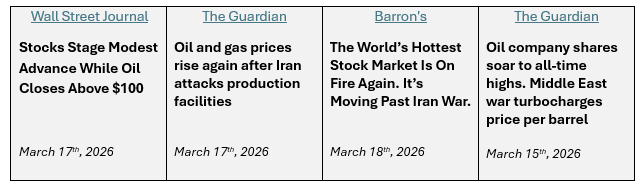
- As of March 16, 2026, U.S. markets have remained relatively stable, with the S&P 500 down only modestly (around ~2%) despite the ongoing conflict
- Energy prices have risen sharply, with oil moving above $100/barrel due to supply concerns
- Certain sectors (like energy and defense) have benefited and surged
- Global markets initially reacted negatively, but in many cases have already begun stabilizing or rebounding
Key takeaway: Markets are reacting but not collapsing. This is consistent with how markets have historically handled geopolitical events.
What History Tells Us (This Matters Most)
Research consistently shows that:
- Markets often dip initially when conflict begins
- They typically recover quickly as uncertainty becomes clearer 1
- Most geopolitical events do not create long-term bear markets 2
- Over time, markets tend to resume their prior trend 2
Historical Perspective: Markets During Major Conflicts

Why This Happens
Geopolitical events impact markets through a few key channels:
- Energy prices (oil shocks)
- Investor sentiment (fear → caution → clarity)
- Short-term economic uncertainty
However:
- Businesses continue operating
- Consumers continue spending
- Innovation and growth do not stop
That’s why markets tend to stabilize and move forward, even during difficult global events.
What This Means for You
At Gates Pass Advisors, this is exactly why we emphasize:
- Diversification to reduce single-event risk
- Long-term planning that takes into account the assumption of short-term swings along the way
- Thoughtful adjustments, not emotional decisions
History is clear: The investors who stay disciplined during uncertain times are often the ones best positioned when markets recover.
A Calm, Grounded Perspective
It’s natural to feel uneasy when global tensions rise. But the data, and decades of market history, tell a consistent story:
- Uncertainty is temporary
- Volatility is normal
- Recovery is typical
We, at Gates Pass Advisors, are actively monitoring developments, and if you’d like to talk through your specific situation, we are always here to help.
CITATIONS:
Headline Links:
Wall Street Journal: Stocks Stage Modest Advance While Oil Closes Above $100
The Guardian: Oil and gas prices rise again after Iran attacks production facilities
Barron’s: The World’s Hottest Stock Market Is On Fire Again. It’s Moving Past Iran War.
The Guardian: Oil company shares soar to all-time highs. Middle East war turbocharges price per barrel
1. Yahoo Finance – Why markets might be having a change of heart about the Iran war
2. Investors – As Iran War Tests Investors, Here’s How to Navigate the Stock Market During A Crisis
Disclosures:
The information contained herein is not intended as tax, legal, or accounting advice. Individual circumstances vary, and tax laws are subject to change. Readers should consult with a qualified tax professional regarding their specific situation before making decisions related to equity compensation.
Advisory services are offered through Gates Pass Advisors, a Registered Investment Adviser. Registration does not imply a certain level of skill or training. Investing involves risk, including the potential loss of principal. Diversification does not guarantee a profit or protect against loss in declining markets.